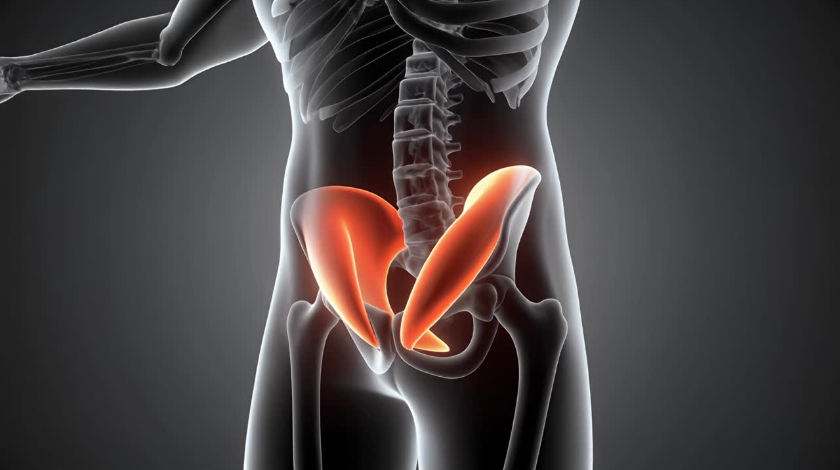
Have you ever stood up from your desk and felt a deep ache in the front of your hip? Or maybe you’ve tried to run, only to be stopped by a sharp pinch in your groin. For years, I struggled with a nagging discomfort in my lower back that no amount of stretching seemed to fix. I blamed my mattress, my chair, even my shoes. It wasn’t until a sharp-eyed physiotherapist poked a finger deep into my abdomen, near my spine, and asked, “Does this hurt?” that I discovered the real villain: my iliopsoas muscle.
This muscle is one of the most influential, yet most misunderstood, parts of your body. It’s the hidden bridge between your torso and your legs, and when it’s unhappy, it can send pain signals to a confusing array of places. Let’s pull back the curtain on this deep core muscle, understand why it causes so much trouble, and learn how to make peace with it, using simple, practical steps.
Part 1: So, What Exactly Is the Iliopsoas?
Let’s break it down without the intimidating textbook language. The name “iliopsoas” (ill-ee-oh-SO-as) is a two-for-one deal. It’s actually a team of two muscles—the psoas major and the iliacus—that join forces to become the primary hip flexor.
Imagine the psoas major as a thick, powerful rope. It originates from the sides of your lower spine (the lumbar vertebrae). Now, picture the iliacus as a fan-shaped muscle that lines the inside of your hip bone (the ilium). These two muscles travel down through your pelvis, merge together, and attach to the top of your thigh bone (femur).
Think of it like this: when you contract your iliopsoas, it’s like pulling on a rope that connects your spine to your thigh. This action is what lifts your knee toward your chest. Every step you take, every time you climb stairs, or even when you just swing your leg out of the car, your iliopsoas is working.
But its job isn’t just about movement. Because of its unique attachment to your spine, it’s also a crucial postural stabilizer. A healthy, balanced iliopsoas helps keep your lower spine in a neutral, supported position. It’s part of your inner core team, working quietly in the background to hold you upright.
Part 2: Why Does This Muscle Cause So Much Grief?
Here’s where modern life gets us into trouble. The iliopsoas is a victim of our lifestyle, and its problems usually boil down to two opposite but connected issues: it’s too tight, too weak, or often both.
The Tyranny of Sitting: This is the number one culprit. When you sit for hours, your hip flexors, led by the iliopsoas, are in a permanently shortened position. Over time, they physically adapt to this length. They become chronically tight and short. When you stand up, these now-tight muscles pull on your spine, often tilting your pelvis forward into an exaggerated arch (anterior pelvic tilt). This strains your lower back muscles, leading to that familiar ache. It’s like wearing a shirt that’s two sizes too small all day—everything feels restricted and pulled out of place.
The Imbalance of Weakness: A tight muscle is not necessarily a strong muscle. In fact, a muscle stuck in a shortened state often becomes weak and lazy. It forgets how to contract properly. So, when you do ask it to work—like during a run or a heavy squat—it might fail or recruit other muscles (like your rectus femoris, another hip flexor) to do its job. This leads to overuse, strain, and pain, often felt as a deep ache in the front of the hip or groin.
Other Common Causes:
-
Overuse in Activities: Runners, cyclists, dancers, and soccer players repetitively flex their hips, which can lead to iliopsoas tendonitis (inflammation) or bursitis (inflammation of the fluid-filled sac near its attachment).
-
Compensating for Weak Glutes: If your butt muscles are inactive (a common issue called “gluteal amnesia”), your iliopsoas and hamstrings will overwork to try to stabilize your hip and pelvis.
-
Acute Injury: A sudden, forceful contraction, like slipping and catching yourself, can strain the muscle.
Part 3: How to Know If Your Iliopsoas Is the Problem
Iliopsoas pain is a master of disguise. It rarely screams its name. Here’s what to listen and feel for:
-
A deep, aching pain in the front of your hip, right where your leg meets your torso.
-
Pain in your groin that may travel down the front of your thigh.
-
Stiffness or pain in your lower back, especially when standing upright after sitting.
-
A clicking or snapping sensation in the front of the hip when you walk, swing your leg, or get up from a chair (this could be “snapping hip syndrome,” where the iliopsoas tendon flicks over the bony structures of the hip).
-
Difficulty with activities that involve lifting your knee, like climbing stairs, running, or kicking.
A Simple Home Check: The Modified Thomas Test
You can get a clue about iliopsoas tightness with this basic test. Lie on your back on a firm bed or table with your legs hanging off the edge, knees bent. Gently pull one knee into your chest, hugging it to keep your lower back flat. Let your other leg (the one you’re testing) relax and hang down.
Look at the hanging leg:
-
If your thigh lifts significantly off the surface, your iliopsoas on that side is likely tight.
-
If your knee stays highly bent (your thigh is down but your calf is parallel to the floor), your rectus femoris (another hip flexor) might be tight.
Important Note: This is a screening tool, not a diagnosis. Pain during this test is a bigger red flag than just tightness. If you feel sharp pain, stop and consult a healthcare professional.
Part 4: Your Practical Guide to a Happier Iliopsoas
The goal isn’t just to stretch it aggressively. It’s to restore balance: release excessive tension, then teach it to be strong and functional at its proper length.
Step 1: Gentle Release (Letting Go)
Forget the intense, painful stretches you see online. Start softly.
-
Half-Kneeling Hip Flexor Stretch: Kneel on one knee (use a cushion), with your front foot flat on the floor. Tuck your pelvis under you—imagine you’re trying to zip up a tight pair of jeans. You should feel a stretch in the front of the hip of your kneeling leg. Hold for 30-45 seconds, breathing deeply. The key is the pelvic tuck, not leaning forward.
-
Supported Release: Lie on your back with a firm pillow or foam roller under your pelvis/sacrum. Let your legs relax completely, knees bent, feet on the floor. This position allows gravity to gently encourage a release in the front of the hips. Stay for 2-3 minutes.
Step 2: Smart Strengthening (Waking It Up)
We need to strengthen the muscle in its lengthened position.
-
Dead Bug: Lie on your back, knees bent 90 degrees over hips, arms reaching to the ceiling. Slowly and with control, lower your opposite arm and leg toward the floor, keeping your lower back pressed flat. Return to center. This teaches your deep core, including the psoas, to stabilize your spine while your limbs move. Do 2 sets of 10 per side.
-
Standing Marching: Stand tall, core engaged. Slowly lift one knee to hip height, pause for 2 seconds, and lower with control. Focus on using the front of your hip, not swinging your leg. This strengthens the iliopsoas in a functional, upright position.
Step 3: The Bigger Picture (Fixing the Team)
-
Strengthen Your Glutes: Bridges, clamshells, and banded walks will take the load off your overworked hip flexors.
-
Improve Your Sitting Posture: Sit on your “sit bones” at the back of your pelvis, not slumped on your tailbone. Get up and move for 2-3 minutes every 30 minutes.
When to Call in the Professionals
If your pain is severe, sudden, involves numbness/tingling down your leg, or doesn’t improve with consistent self-care after a few weeks, see a physiotherapist or doctor. They can provide an accurate diagnosis, rule out other issues (like hip labral tears or arthritis), and offer hands-on treatment like manual therapy or targeted dry needling.
Conclusion
Your iliopsoas is more than just a hip flexor; it’s a vital link in your body’s kinetic chain, connecting your stability to your movement. Neglecting it, often by simply sitting too much, can lead to a cascade of discomfort in your hips, groin, and back. The solution isn’t found in one magic stretch, but in a consistent practice of mindful movement, balanced strengthening, and breaking up long periods of sitting. By listening to your body and giving this deep, core muscle the care it deserves, you can build a foundation for more fluid, powerful, and pain-free movement in everything you do.
FAQ
Q: Can a tight psoas really cause lower back pain?
A: Absolutely. A tight psoas pulls down on the front of your lumbar spine, increasing the arch in your lower back. This puts constant pressure on the facet joints and discs in your back and strains the muscles that have to work overtime to oppose that pull, leading to ache and stiffness.
Q: How long does it take to release a tight iliopsoas?
A: There’s no one-size-fits-all answer. If the tightness is purely from recent overuse, you might see improvement in a week or two with consistent gentle stretching and movement. If it’s a long-term postural adaptation from years of sitting, it may take several months of dedicated work to change the muscle’s resting length and strength patterns. Patience and consistency are key.
Q: Is it bad to stretch my iliopsoas every day?
A: Gentle, mindful stretching (like the half-kneeling stretch with proper form) can be done daily. However, aggressive, painful stretching can trigger a protective response, making the muscle tighter. Listen to your body. Focus on feel-good movement and strengthening just as much as stretching.
Q: What’s the difference between iliopsoas pain and a hip joint problem?
A: Iliopsoas pain is typically muscular or tendinous—aching, pulling, often related to specific movements or postures. True hip joint pain (like from arthritis) is often felt deeper in the groin or buttock, may be sharper, and can cause stiffness and reduced range of motion in all directions. A healthcare professional can perform specific tests to differentiate between the two.
Leave a Reply