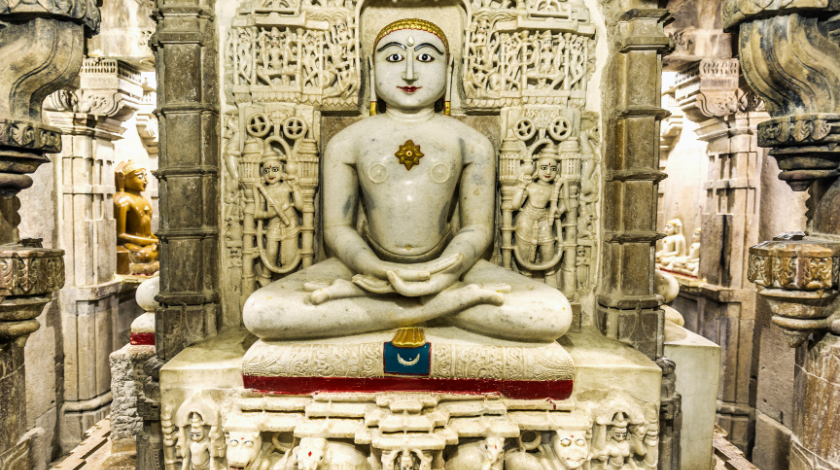
I remember the first time I walked into a Jain temple. It wasn’t the grandeur that struck me, though it was beautiful. It was the profound, palpable silence. It wasn’t an empty silence, but a thick, thoughtful one, like the quiet after a deep conversation. People moved with a gentle awareness, and there was a sense of calm that felt radically different from the bustling city outside. That experience sparked a curiosity in me about Jainism, or “Jainismus” as it’s known in German, a tradition often mentioned alongside Hinduism and Buddhism but somehow less understood. If you’ve ever wondered what Jainism is truly about beyond its famous principle of non-violence, join me. Let’s unravel this ancient, beautiful, and surprisingly relevant philosophy together, in simple words.
Jainism is one of the world’s oldest living religions, originating in ancient India. Its core isn’t about worshipping a creator god, but about discovering the divine, the perfect, and the liberated within every single soul. Jains believe the universe is eternal, and every living being, from a human to an ant or even a microscopic organism, is a soul (they call it Jiva) trapped in a cycle of birth, death, and rebirth, known as Samsara. This cycle is powered by Karma, understood not as fate, but as a subtle matter that sticks to the soul based on our actions, thoughts, and desires. The ultimate goal? To shed all this karmic matter through ethical living and spiritual discipline to achieve Moksha—absolute liberation, infinite knowledge, and eternal bliss.
Now, if you think this sounds complex, you’re right. The depth of Jain philosophy is immense. But it all rests on a few breathtakingly simple and powerful ideas. The first, and most famous, is Ahimsa. You’ve probably heard it as “non-violence.” But in Jainism, Ahimsa is not just a rule. It is the religion. It is an all-encompassing love and respect for life. We often limit non-violence to physical actions—not hitting someone, being vegetarian. For Jains, it runs much deeper. It means non-violence in speech—avoiding harsh words, lies, or gossip that can hurt others. Even more challenging, it means non-violence in thought—rooting out hatred, anger, or ill-will from our own minds. I once spoke with a Jain friend who explained why they gently sweep the path before walking and wear a cloth over their mouth. It’s not superstition. It’s an active, daily practice of Ahimsa to avoid accidentally harming insects or even microscopic life forms in the air. This radical commitment forces a constant, mindful awareness of your connection to all living things. It’s a level of responsibility that is both daunting and deeply inspiring.
This leads us to the second pillar, which, in my opinion, is Jainism’s greatest gift to the modern world: Anekantavada, or the principle of “many-sidedness.” In an age of social media shouting matches and absolute “us vs. them” thinking, Anekantavada is a soothing balm. It states that truth and reality are perceived differently from different points of view, and that no single perspective holds the complete truth. The classic story used to explain this is the parable of the blind men and the elephant. One feels the leg and says an elephant is like a pillar. Another feels the trunk and insists it’s like a hose. Another touches the side and is sure it’s a wall. They are all correct from their limited experience, and all incorrect in their absolute conclusions. Anekantavada teaches intellectual humility. It reminds me to pause when I’m absolutely certain I’m right. It encourages me to ask, “What piece of the elephant am I missing? What can the other person’s perspective teach me?”
Linked to this is Syadvada, the “maybe” doctrine. It’s a practical tool for speech. Since absolute truth is complex, Jains often qualify statements with “maybe” or “from a certain perspective.” This isn’t wishy-washy. It’s incredibly precise and respectful. It acknowledges the limitations of human language and perception. Imagine if our political or online discussions were infused with this spirit. Instead of “You are wrong!” we might say, “From my understanding, based on these facts, I see it this way. What is your viewpoint?” This framework prevents the dogmatic rigidity that causes so much conflict.
The path to embodying Ahimsa and understanding Anekantavada is walked via the Three Jewels: Right Faith, Right Knowledge, and Right Conduct. Think of them as a tripod—all three legs are needed for stability. Right Conduct is guided by vows. For monks and nuns, these are the five Mahavratas (Great Vows): strict non-violence, truthfulness, non-stealing, celibacy, and non-possession. For laypeople like you and me, there are the Anuvratas (Limited Vows), which adapt these principles to a householder’s life. The vow of non-possession, Aparigraha, is particularly fascinating today. It’s not just about not hoarding wealth, but about detaching from mental possessions—our clinginess to opinions, relationships, even identities. In our consumerist world, the idea that true happiness comes from wanting less, not having more, feels revolutionary.
Who laid down this path? Jainism speaks of 24 great teachers, the Tirthankaras or “ford-makers,” who rediscover and teach the eternal path in different eras. The last of these, and the most historically documented, is Lord Mahavira, a contemporary of the Buddha. Born a prince, he renounced his kingdom at 30 to seek spiritual truth. After 12 years of intense meditation and asceticism, he attained Kevala Jnana (perfect omniscience) and spent the rest of his life teaching. His life story is a testament to the power of extreme discipline and renunciation for a higher goal.
Over centuries, interpretations of practice led to the two main branches: the Digambara (sky-clad) monks, who believe in complete non-possession, including clothing, and the Svetambara (white-clad) monks and nuns, who wear simple white robes. Both share the same core principles. The daily life of a Jain layperson is shaped by these principles. You’ll see it in their strictly vegetarian, and often vegan, diet that excludes root vegetables to avoid harming the entire plant. You see it in their practice of fasting, not as punishment, but as a spiritual exercise to strengthen willpower and detach from bodily desires. Major festivals like Paryushana are times for intense reflection, fasting, listening to scriptures, and seeking forgiveness from all living beings.
So, why does this ancient philosophy matter to us now? I believe Jainism offers urgent tools. In an ecologically fragile world, Ahimsa provides an ethical foundation for environmentalism—seeing ourselves as part of a web of life, not its masters. In a socially fractured world, Anekantavada teaches us the humility to listen and the wisdom to see complexity. And in a world obsessed with more, Aparigraha points to the profound peace of enough.
My journey into understanding Jainism hasn’t made me a Jain. But it has deeply changed me. It has made me more careful—with my words, my actions, and my judgments. It has planted a small “maybe” in my certainties, creating space for dialogue. It has shown me that the most radical revolutions often begin not with loud protests, but with a quiet, determined commitment to cause no harm, to hold space for multiple truths, and to seek freedom not by acquiring the world, but by letting go of the endless wants that bind us to it. In that silent temple, I now understand, I wasn’t sensing an absence of noise. I was feeling the presence of a profound, active peace.
Conclusion
Jainism, therefore, is far more than a historical Indian religion. It is a living philosophy of intense compassion, intellectual humility, and personal responsibility. From its radical commitment to Ahimsa to its graceful doctrine of Anekantavada, it challenges us to expand our circle of empathy and question our own certainties. While its ascetic ideals may seem daunting, its core message is universally accessible: true peace comes from minimizing harm, in thought, word, and deed, and from recognizing the partial nature of our own truths. In a complex modern world, these ancient teachings offer a timeless guide toward a more mindful, compassionate, and less dogmatic way of living.
Frequently Asked Questions (FAQ)
1. Are Jains Hindus?
No, Jainism is a distinct and independent religion with its own scriptures, philosophy, and spiritual lineage. While they originated in the same Indian cultural milieu and share some concepts like karma and rebirth, their core beliefs and practices are different. Jains do not accept the authority of the Hindu Vedas.
2. Do Jains worship gods?
Jainism focuses on the liberation of the soul rather than on a creator god. Jains venerate the Tirthankaras, not as gods who grant wishes, but as perfected beings and supreme teachers who have shown the path to liberation. Worship is a form of deep respect and a means to inspire one’s own spiritual journey.
3. Is the Jain practice of Santhara (Sallekhana) a form of suicide?
This is a sensitive and often misunderstood point. From the Jain perspective, Santhara is not suicide, which is seen as a violent, emotionally charged act done in despair. Santhara is a highly venerated, voluntary, and gradual renunciation of food and water at the end of a natural life, undertaken with religious preparation and clarity of mind when the body is no longer capable of spiritual progress. It is viewed as the ultimate practice of non-attachment and a peaceful, conscious parting from the physical body.
4. What is the main difference between Digambara and Svetambara Jains?
The most visible difference is in monastic practice. Digambara monks practice complete non-possession (Aparigraha), which includes not wearing any clothes. Svetambara monks and nuns wear simple white robes. There are also some differences in which scriptures they accept and in some minor mythological details. However, both sects agree on the fundamental principles of Jain philosophy.
5. Can anyone practice Jain principles?
Absolutely. While taking the full monastic vows is a specific commitment, the core ethical principles of Jainism are universal. Practicing greater non-violence in your diet (like eating less meat), speaking more truthfully and kindly, practicing intellectual humility (Anekantavada), and consciously reducing clutter and attachment in your life (Aparigraha) are valuable practices anyone can adopt, regardless of their religious background.
Leave a Reply