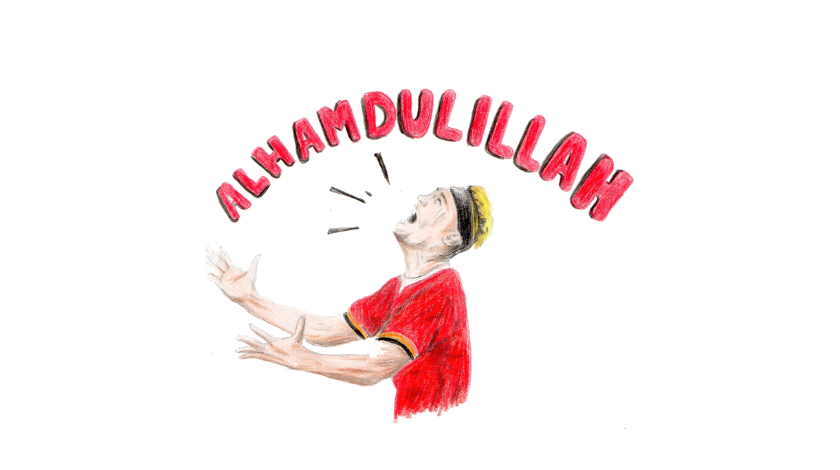
Have you ever been around Muslim friends or colleagues and noticed how often the word “Alhamdulillah” comes up in conversation? Someone asks, “How are you?” The answer is, “Alhamdulillah, I’m well.” Good news is shared, and the response is, “Alhamdulillah!” Even in the face of a challenge, you might hear a sigh followed by, “Alhamdulillah ala kulli haal.” For years before I embraced Islam, I heard this word and understood it as a simple “thank God.” But I always sensed there was a weight to it, a substance that made it feel different from a casual “thanks.” It was only when I began to learn its true meaning that I realized “Alhamdulillah” isn’t just a phrase; it’s a complete worldview packed into a single, beautiful term.
Let me share a small moment that stuck with me. Once, during a hectic work week where everything seemed to go wrong, I was venting to a Muslim mentor of mine. My computer had crashed, I was late on a deadline, and I had a cold. After my rant, he listened patiently, nodded, and simply said, “Alhamdulillah.” I was almost annoyed. Alhamdulillah for this mess? He smiled and explained, “Alhamdulillah your computer crashed today and not the day of your big presentation. Alhamdulillah you have a job that gives you deadlines. Alhamdulillah you have a health that allows you to feel a common cold, unlike many in hospitals. We say it not because the situation is good, but because Allah is always worthy of praise.” That moment was a turning point for me. It reframed everything.
So, what does “Alhamdulillah” actually mean? Let’s break it down. The word comes from classical Arabic, made of three parts: “Al,” “Hamd,” and “Lillah.” “Al” is simply the definite article “the.” “Hamd” is a rich, nuanced word that encompasses praise, thanks, commendation, and even admiration. It’s deeper than “shukr,” which is thanks for a specific favor. “Hamd” is a general, heartfelt praise of someone’s inherent qualities and blessings, whether you’ve directly received something or not. “Lillah” means “to Allah” or “for Allah.” Put it all together, and “Alhamdulillah” translates to “All praise and thanks are for Allah alone.”
This is the first crucial difference from a simple “thank you.” When we say “thanks,” we usually direct it to the person who did us a favor. “Alhamdulillah” redirects that ultimate gratitude upwards. It acknowledges that while people are the means, the ultimate source of any and every blessing, big or small, is the Creator. It’s an act of recognizing the origin of all good.
You might wonder, when exactly do people say this? The beauty is in its boundless application. Of course, we say it in moments of obvious joy: getting a promotion, hearing good news about family, or enjoying a delicious meal. But its real power shines in its constant use in daily rituals. Muslims say it multiple times in their five daily prayers. We say it after sneezing (and the response is “Yarhamuk Allah,” meaning “May Allah have mercy on you”). It’s the recommended phrase to say upon completing the Quran.
More profoundly, Islam teaches us to say “Alhamdulillah” in moments of trial. This is where the philosophy truly deepens. The Prophet Muhammad (peace be upon him) taught that for a believer, every situation is good. If he encounters something pleasant, he is grateful, and that is good for him. If he encounters adversity, he is patient, and that is good for him. Saying “Alhamdulillah” during hardship is not about being fake happy. It is an affirmation of faith. It means, “I praise You, Allah, not because this feels good, but because I trust Your wisdom. I praise You because even in this, I know there is a purpose, a lesson, or a forgiveness that I cannot see.” The full phrase “Alhamdulillah ala kulli haal” means “All praise is for Allah in every situation.”
This practice has a tangible, psychological effect, something modern science is only now catching up to under the term “positive psychology.” Consistently acknowledging gratitude rewires your brain to scan for positives rather than negatives. When your first instinct upon facing a minor inconvenience—like stuck traffic—is to sigh and then whisper “Alhamdulillah,” you force a cognitive shift. You might follow it with, “Alhamdulillah for a safe car. Alhamdulillah for the time to listen to a podcast. Alhamdulillah I have somewhere to go.” It moves you from a state of lack to a state of abundance.
From an Islamic spiritual perspective, the benefits are profound. The Quran is filled with reminders to be grateful. One verse that always resonates with me is: “And [remember] when your Lord proclaimed, ‘If you are grateful, I will surely increase you [in favor]’” (Surah Ibrahim, 14:7). This promise is understood both materially and spiritually. Gratitude doesn’t just preserve blessings; it attracts an increase. It increases your inner peace, your contentment, and your ability to see the countless blessings you were previously blind to. The Prophet Muhammad said, “How wonderful is the affair of the believer! His affair is always good, and that is for no one except the believer. If something good happens to him, he is grateful, and that is good for him. If something bad happens to him, he is patient, and that is good for him.”
So, how can you, whether Muslim or simply someone seeking a more grateful life, incorporate this? Start small and sincerely. In the morning, when you wake up, instead of grabbing your phone, take three deep breaths and say “Alhamdulillah for a new day.” Make it a habit before eating. When someone asks how you are, mean it when you say “Alhamdulillah.” Try to find one specific thing to mentally praise Allah for in that moment. The key is to connect the word with genuine feeling, not just make it a robotic utterance.
Writing it can also be a point of curiosity. In Arabic, it is written as ٱلْحَمْدُ لِلَّٰهِ. The calligraphy of this phrase is some of the most common and beautiful in Islamic art, symbolizing the central role of gratitude in faith.
I will be honest, this is a lifelong practice, not a perfect one. There are days when “Alhamdulillah” feels heavy on my tongue, when complaining seems far easier. But on those days, I remember that even the attempt, the struggle to say it, is a form of worship in itself. It is a conscious choice to reject entitlement and embrace humility. It is a reminder that I am not the source of my own success, my health, or my provisions. It grounds me.
In a world that constantly tells us we need more to be happy, “Alhamdulillah” is a revolutionary statement of contentment. It is an acknowledgment that at this very moment, you have enough. You are enough. Because the Source of all things is with you. It builds a direct, personal relationship between you and the Divine, where you are constantly in a loop of receiving, acknowledging, and praising.
That, in essence, is the secret. “Alhamdulillah” transforms gratitude from a reaction to a state of being. It makes you an active seeker of blessings in the fabric of your ordinary, everyday life. You start to see the blessing of sight, of coherent thought, of a functioning heart, of a cool glass of water. The small miracles become overwhelming, and your natural state becomes one of praise. You begin to live the meaning, not just say the word.
Conclusion
Learning about “Alhamdulillah” has been less about mastering a word and more about training a gaze—a way of seeing the world. It has taught me that gratitude is not a passive response to obvious good fortune, but an active lens through which to experience everything. It’s the decision to praise the Giver, regardless of the immediate taste of the gift. This isn’t a spiritual bypass for pain or difficulty; it’s a profound act of acknowledging a reality larger than our current circumstance. It roots us.
In a daily life that often feels chaotic and demanding, this simple phrase is my reset button. It pulls me out of the spiral of “what’s next” or “what’s lacking” and plants me firmly in the “what is.” A traffic jam becomes a moment of pause. A challenge becomes a potential lesson. A simple meal becomes a feast of blessing. The more I’ve practiced it, the more I’ve found that “Alhamdulillah” doesn’t just describe gratitude—it actively generates it. It builds a sanctuary of contentment within, one whispered praise at a time.
So, whether you embrace Islam or simply seek more peace, I invite you to try it. Let “Alhamdulillah” be more than a word you hear. Let it be a small, gentle revolution in your heart. Start with the warmth of your coffee, the health in your body today, or the love of a single person. Redirect that feeling of thanks upward and outward. You might just find, as I did, that it begins to change everything, not by altering your life, but by transforming how you see the life you already have.
Frequently Asked Questions (FAQs)
Q1: What is the exact English translation of Alhamdulillah?
While “Praise be to God” or “All praise is due to God” are the closest translations, they don’t fully capture the depth. “Alhamdulillah” carries the specific meaning of all praise and thanks being directed to the One God (Allah) alone, encompassing both gratitude for specific favors and general praise for His eternal nature and blessings.
Q2: When should I say Alhamdulillah?
You can and should say it at all times:
-
In good times: When receiving good news, enjoying a blessing, or achieving a goal.
-
In daily life: Upon waking up, before and after eating, after sneezing.
-
In worship: Multiple times during the five daily prayers and after completing acts of worship.
-
In difficult times: As an expression of faith and patience, acknowledging that Allah’s wisdom is beyond our understanding. The phrase “Alhamdulillah ala kulli haal” (praise be to Allah in every situation) is often used here.
Q3: How do I respond when someone says Alhamdulillah?
There’s no fixed ritual response like “Amen.” Often, you can simply smile and nod in agreement, or echo the sentiment. If someone says it after sneezing, the specific response is “Yarhamuk Allah” (May Allah have mercy on you).
Q4: What is the difference between Alhamdulillah and Mashallah?
This is a common and important distinction. Alhamdulillah is an expression of gratitude and praise to Allah. You say it for blessings you have or experience. Mashallah (ما شاء الله) means “What Allah has willed.” You say it to appreciate something beautiful or impressive in someone else (like their child, their success, or their possession), as a way to praise Allah’s creation and simultaneously ward off any negative effects of envy or the evil eye.
Q5: Can non-Muslims say Alhamdulillah?
Absolutely. It is a phrase of universal gratitude. Many Arabic-speaking Christians use it as well. Using it with an understanding and respectful intention is always welcomed. It is a beautiful way to express a shared human experience of thankfulness.
Q6: How do you write Alhamdulillah in Arabic?
It is written as ٱلْحَمْدُ لِلَّٰهِ. The art of calligraphically writing this phrase is highly revered in Islamic culture, symbolizing the centrality of gratitude.
Q7: What if I don’t feel grateful when I say it?
The beauty of the practice is that the feeling often follows the action. Islam values the intention and effort of the heart. Even if you say it while struggling, the very act is an affirmation of your desire to be grateful and your acknowledgment of Allah’s sovereignty. It is a step of faith, and with consistency, the feeling of sincere gratitude will grow, God willing.
Leave a Reply