Let’s be honest. When most people plan a trip to Scotland, they think of Edinburgh’s castle, Glasgow’s buzz, or the wild Highlands. I was exactly the same. Falkirk? It was just a name on the map, a town you might pass on the train. That was until a local friend practically insisted I spend a day there. “You’re missing a trick,” she said. And you know what? She was completely right. My day in Falkirk turned out to be one of the most surprising and enjoyable experiences I’ve had in Central Scotland. It’s a place where ancient history, industrial heritage, and mind-blowing modern art collide in the most spectacular way. If you’re looking for an easy, rewarding day trip that packs a real punch, let me tell you why Falkirk should be at the top of your list.
The Heart-Piece: Experiencing the Falkirk Wheel
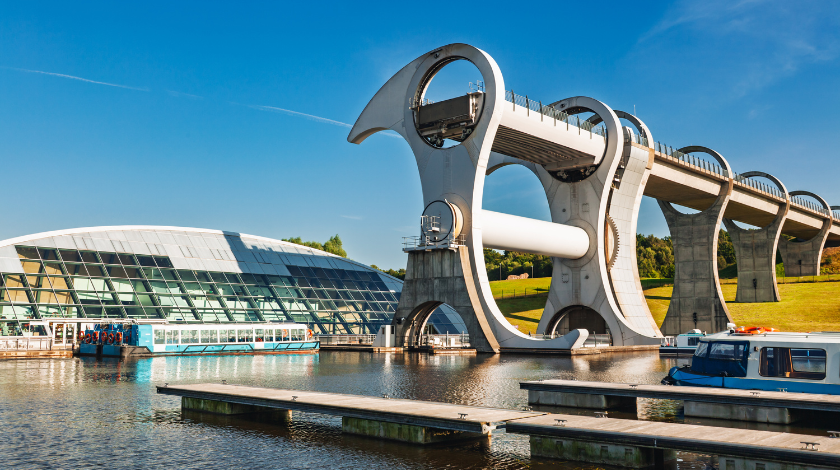
Your Falkirk adventure almost has to start with its most famous resident: The Falkirk Wheel. I’d seen pictures, but nothing prepares you for seeing it in person. It rises from the landscape like a piece of giant, beautiful scaffolding. But this is no static sculpture; it’s a fully functioning, rotating boat lift – the only one of its kind in the world.
Here’s the simple genius of it. For centuries, the Forth & Clyde Canal and the Union Canal were linked by a series of 11 locks. It took nearly a full day for a boat to travel up or down. When they decided to reconnect the canals in the 21st century, they didn’t just rebuild the locks. They built this. The Wheel is a monumental piece of engineering that acts like a rotating lift for boats. It picks them up in one of its two giant gondolas, rotates 180 degrees in a beautifully smooth motion, and sets them down on the other canal, a staggering 24 metres higher or lower. The whole process takes about 15 minutes and uses remarkably little energy – in fact, they say it uses about the same power as boiling eight kettles.
I booked a boat trip that takes you onto the Wheel itself. Gliding into that water-filled caisson is a surreal feeling. The gates close behind you, and slowly, silently, the world begins to tilt. You’re lifted up into the air, getting a stunning panoramic view of the surrounding hills. There’s no jolting, just a gentle, majestic turn. It’s a demonstration of pure physics that feels like magic. The visitor centre does a great job explaining the mechanics, but honestly, seeing it work is the best explanation you can get. Is it worth visiting? Absolutely. It’s not just something to look at; it’s an experience to be part of.
Mythical Guardians: Meeting The Kelpies at Helix Park
About fifteen minutes’ drive from the Wheel (or a lovely canal-side walk or cycle if you’re feeling active) lies Falkirk’s other showstopper: The Kelpies. Again, photos don’t do them justice. As you approach The Helix Park, a vast green space designed for community and visitors, you’ll see them from afar. Two horse-head sculptures, each 30 metres tall – that’s as high as a ten-story building – glinting in the Scottish light.
These aren’t just any horses. They are Kelpies, shape-shifting water spirits from Celtic mythology said to haunt Scotland’s lochs and rivers, often appearing as horses. Artist Andy Scott created them as a monument to the horse-powered heritage of Scottish industry and the mythical creatures of folklore. Up close, their scale is utterly breathtaking. The steel plates they’re made from reflect the sky, turning grey on a cloudy day and glowing fiery gold at sunset. You can walk right between their towering legs and look up into their detailed, powerful faces.
I visited in the late afternoon, and as the sun dipped, the park lights began to glow. The Kelpies are spectacular during the day, but they become truly ethereal at dusk. There’s a guided tour that lets you go inside one of the heads, which I’d recommend for a unique perspective. The Helix Park itself is a wonderful place to spend a couple of hours. There’s a massive adventure playground for kids, a lagoon for paddle sports, and miles of flat, accessible paths. I grabbed a coffee from the visitor hub and just sat for a while, watching people react to the sculptures with the same awe I felt. It’s a powerful, free-to-view public art installation that has completely transformed this area.
Walking Through Layers of History
What really sealed Falkirk for me was discovering that it’s not just about these modern wonders. The town is built on layers of fascinating history, and you can literally walk through it.
First, there’s the Antonine Wall. Long before Hadrian’s Wall, the Romans pushed north into what is now Scotland and built this frontier. Designated a UNESCO World Heritage Site, it ran right through Falkirk. You can’t see a towering wall here; it was mostly a turf rampart with a deep ditch in front. But at sites like Watling Lodge or Rough Castle, you can still trace the unmistakable line of the ditch snaking across the landscape. Standing there, trying to imagine Roman sentries looking out from a fort into the misty north, gives you a real shiver of connection to the past. It’s a quieter, more reflective experience than the Wheel or Kelpies, but utterly compelling for anyone interested in our ancient past.
Then, jump forward a few centuries to Callendar House. This is a magnificent stately home set in its own beautiful park. Its story stretches from a medieval tower to a bustling Victorian mansion. What I loved is how alive it feels. Down in the 1820s kitchen, costumed interpreters were baking over an open fire, and the smell of shortbread filled the air. You can explore grand reception rooms and even see a historical exhibit on the life of Antonine Wall pioneer Sir George Macdonald. The park grounds are perfect for a leisurely stroll. It offers a tangible, elegant link to the more recent past, a contrast to the raw ancient history of the Wall and the futuristic feel of the Kelpies.
Making the Most of Your Visit: Practical, Friendly Advice
Based on my experience, here’s how to build your perfect day.
-
Getting There & Around: Falkirk is incredibly accessible. Trains from Edinburgh or Glasgow take about 30 minutes and arrive at Falkirk Grahamston station (closer to the town centre) or Falkirk High. The key sites are a bit spread out. The best way is to drive, as parking at both the Wheel and The Helix is ample and cheap. If you’re relying on public transport, local buses (like the number 3) connect the train stations, the town centre, The Kelpies, and the Falkirk Wheel, but check timetables.
-
The Perfect Itinerary: Start at the Falkirk Wheel for a morning boat trip. Have lunch at their cafe or bring a picnic. Then, drive or take the connecting bus to The Kelpies and Helix Park. Spend the afternoon exploring the park and visiting the Kelpies up close. If you have time and energy, finish with a stroll at Callendar House or a section of the Antonine Wall.
-
Tickets: You can see The Kelpies and Helix Park for free. Parking costs a small fee. The Falkirk Wheel boat trip requires a ticket, which you should book online in peak season. Entry to Callendar House has a small charge, but the park is free.
-
What to Wear: This is Scotland, so layers and a waterproof jacket are non-negotiable, even in summer! Wear comfortable shoes – you’ll be doing a lot of walking on mostly flat, good paths.
Conclusion: The Town That Will Surprise You
My day in Falkirk completely changed my perception. It stopped being just a name on a map and became a place of vivid memories: the gentle rotation of the Wheel, the colossal shimmer of the Kelpies against a moody sky, and the quiet ditch of a Roman wall. It’s a destination that celebrates human ingenuity – from ancient empire builders to visionary artists and engineers. It’s family-friendly, steeped in history, and visually stunning. So, if you’re crafting your Scottish itinerary and looking for that perfect, manageable day trip that offers something genuinely different, take it from someone who was once a skeptic: give Falkirk a day. You will leave impressed, delighted, and full of stories to tell.
FAQ About Visiting Falkirk
Q: Is one day enough for Falkirk?
A: Absolutely. One full day is perfect to see the main highlights: the Falkirk Wheel, The Kelpies, and one of the historical sites like Callendar House or a section of the Antonine Wall.
Q: Can you get between the Falkirk Wheel and The Kelpies without a car?
A: Yes. There’s a dedicated, signposted footpath and cycle path along the canal that connects them (about a 45-minute walk). A seasonal shuttle bus also operates between the two sites, and local public buses (number 3 route) connect them via the town centre.
Q: Are The Kelpies free to visit?
A: Yes, seeing The Kelpies in the park is completely free. You only need to pay for parking at The Helix Park and if you choose to take the guided tour inside one of the sculptures.
Q: What is the best time of day to see The Kelpies?
A: They are impressive any time! However, late afternoon or dusk is particularly magical when they are illuminated. Sunny days make their steel plates shine brilliantly.
Q: Is the Falkirk Wheel worth the ticket price?
A: If you have any interest in engineering, unique experiences, or just want to see something truly remarkable, yes. The boat trip is a hands-on, memorable activity that explains the landmark better than any observation deck could. For those on a tight budget, you can view the Wheel operating from the visitor centre for free.
Q: Is Falkirk good for kids?
A: Extremely. The Falkirk Wheel is like a giant toy, The Helix Park has one of the best playgrounds in Scotland, and the open spaces are great for running around. The history is presented in a very accessible way at Callendar House.
Leave a Reply