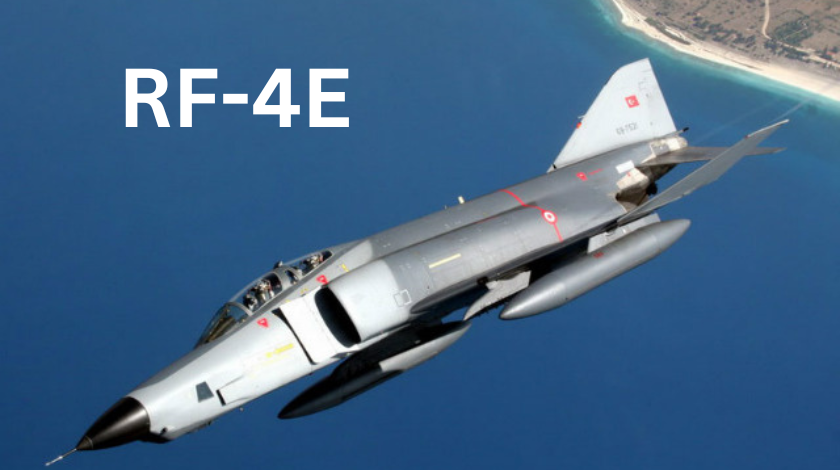
Let’s talk about the F-4 Phantom II. You probably picture a hulking jet laden with missiles, a smoky trail behind its two powerful engines, the very image of Cold War muscle. That’s the Phantom everyone knows. But I’ve always been fascinated by its quieter, more secretive sibling—the one designed not to destroy, but to see. This is the story of the RF-4E, the tactical reconnaissance Phantom, and specifically, how it became the long-serving “eyes” of the Japanese islands.
My own first encounter with an RF-4E was in a dusty photo book from the 80s. It showed this sleek, grey jet with a curiously elongated nose, lacking the telltale gun or missile pylons. It looked purposeful, mysterious. It wasn’t there to fight; it was there to know. That distinction hooked me. In a world obsessed with dogfighting and bomb loads, the reconnaissance bird does the homework that makes everything else possible. Today, we’re going to peel back the layers on this incredible aircraft.
From Fighter to Snooper: Redesigning an Icon
The basic F-4E was a formidable multi-role fighter. To turn it into the RF-4E, engineers at McDonnell Douglas didn’t just slap a camera in the nose. They completely reimagined the front end. The iconic radar cone and gun were removed. In their place, they installed a new, flattened nose section packed with a sophisticated array of photographic and sensor equipment.
Think of it like this: if a standard F-4 was a Swiss Army knife with every tool ready for combat, the RF-4E was a dedicated, high-powered microscope. Its “weapons” were its sensors. The cockpit layout was also altered, with the rear seat dedicated to operating the complex suite of reconnaissance systems, making the Weapon Systems Officer (WSO) truly the eyes of the mission. This wasn’t a simple conversion; it was a ground-up redesign for a single, vital purpose: to gather intelligence from high altitude, at high speed, and in any weather, without being detected or engaged.
Inside the Camera Nose: The RF-4E’s Sensor Suite
So, what exactly was in that famous long nose? The RF-4E’s strength was its modular, multi-sensor approach. It didn’t rely on just one type of camera.
The workhorse was often the KS-127B panoramic camera. This wasn’t your point-and-shoot. It could take razor-sharp, continuous strip photographs from side to side, covering a huge swath of terrain below in a single pass. Imagine flying at over Mach 1 at 40,000 feet and being able to capture detailed images of an area miles wide. This was critical for mapping and broad surveillance.
But it had friends in there too. The jet could carry various combinations of vertical, oblique, and split-image cameras for different angles. For low-light or night missions, it could use infrared line scanners, which detected heat signatures rather than light—perfect for spotting hidden vehicles or facilities. It also housed an AN/APQ-99 forward-looking radar for terrain-following and ground mapping, allowing it to scream in at low level, automatically ducking hills and valleys to avoid enemy radar, before popping up to snap its pictures.
This blend of technologies meant the RF-4E was not just a fair-weather friend. It was an all-weather, day-and-night intelligence gatherer. The film from these cameras would be rushed to developing units after landing, providing commanders with physical, undeniable evidence of what was happening behind enemy lines.
Japan’s Exclusive Phantom: The RF-4EJ and “Peace Eagle”
Here’s where the RF-4E story gets particularly unique. While the US used variants like the RF-4C, the RF-4E was essentially an export model. And its most famous, most dedicated operator was the Japanese Air Self-Defense Force (JASDF).
Japan acquired the RF-4E under the “Peace Eagle” program in the early 1970s. They needed a modern, capable reconnaissance platform to monitor the vast seas and territories around their archipelago, especially during the tense Cold War period. But Japan, with its advanced industrial base, didn’t just buy them off the shelf. The first batch was built by McDonnell Douglas, but subsequent aircraft were license-built by Mitsubishi Heavy Industries in Japan, designated locally as the RF-4EJ.
This local production is a key point. It wasn’t just about buying a plane; it was about technology transfer and integrating the aircraft deeply into Japan’s own defense ecosystem. Mitsubishi’s involvement meant Japan could maintain, modify, and support these jets independently for decades. Walking around a preserved RF-4EJ at a Japanese museum, you can see the Mitsubishi placards next to the McDonnell Douglas plates—a tangible symbol of this partnership.
A Life of Silent Service: The RF-4E in Action
Flying the RF-4E was a different kind of thrill. I once spoke to a former JASDF RF-4E backseater (the reconnaissance systems officer). He told me their missions were often long, solitary, and required intense focus. They would fly out over the Pacific, sometimes shadowing foreign fleets or conducting routine surveillance of remote islands. The job was about patience and precision, not aggressive maneuvering.
“The cockpit was a hum of cooling fans for the cameras and the constant whir of the film advance,” he described. “Your world was the viewfinder and the sensor displays. You’re not looking for a fight; you’re trying to be a ghost, to see without being seen. Getting back with a full canister of film that told a clear story—that was the victory.”
These jets served as Japan’s primary long-range reconnaissance asset for over 40 years. They never fired a shot in anger, but the intelligence they gathered was foundational to Japan’s national defense posture. They were the silent sentinels, a constant reminder that knowledge is the first and most crucial layer of security.
The Sunset Years and a Lasting Legacy
All good things must come to an end. Technology, primarily the shift from film-based to real-time digital sensor pods and satellites, began to render the dedicated RF-4E’s specific design obsolete. Maintaining the aging airframes also became increasingly costly. The JASDF began to phase out its RF-4E fleet in the 2010s, with the last official reconnaissance flight occurring in 2020.
Their role was largely taken over by Mitsubishi F-15J fighters equipped with advanced reconnaissance pods. This was a sign of the times: why have a dedicated airframe when you can give a multi-role fighter a “camera bag” that does the same job, and often better with digital, real-time data-links?
Today, several RF-4Es are preserved in museums across Japan, like at Hamamatsu Air Base. They stand as proud relics of a bygone analog era—a time when intelligence was captured on physical film and required a specialized, majestic jet to go and get it. They represent the peak of a certain technological philosophy: build a machine to do one thing, and do it extraordinarily well.
Conclusion
The RF-4E Phantom, especially in its Japanese RF-4EJ guise, was more than just a variant of a famous fighter. It was a dedicated, sophisticated intelligence platform that played a critical, silent role for decades. It bridged the gap between the risky, low-level photo runs of the Korean War and today’s digital, pod-based surveillance. It took the robust, reliable Phantom airframe and turned it into a flying camera shop, proving that sometimes the most powerful weapon is perfect information. For aviation enthusiasts and history buffs, the RF-4E stands as a testament to specialized engineering and the quiet, unseen missions that shape history.
Frequently Asked Questions (FAQ)
Q1: What does the “RF” in RF-4E stand for?
A: In US military aircraft designation, “R” stands for Reconnaissance, and “F” stands for Fighter. So, “RF” denotes a reconnaissance-fighter aircraft, though in the RF-4E’s case, the fighter capability was secondary to its spy role.
Q2: Could the RF-4E Phantom fight or defend itself?
A: This is a common question. The standard RF-4E had no internal gun and was not wired for air-to-air missiles on its pylons. Its primary defense was its speed and low-altitude terrain-following ability to avoid interception. Some later JASDF RF-4EJs were modified to carry bombs for secondary attack roles late in their service.
Q3: What replaced the RF-4E in Japan?
A: The Japanese Air Self-Defense Force replaced the RF-4E with reconnaissance pods carried by its fleet of Mitsubishi F-15J Eagles. These modern pods provide digital, real-time imagery, making the dedicated film-based reconnaissance jet obsolete.
Q4: Was the RF-4E used by any other country besides Japan?
A: Yes, though Japan was its most prominent operator. Other countries that used the RF-4E included Germany, Israel, Iran, and Turkey. Each nation often had specific modifications to suit their needs.
Q5: Where can I see an RF-4E today?
A: Several are preserved in museums. In Japan, the Hamamatsu Air Park and the JASDF Gifu Museum have examples. In the United States, you can find ex-German and ex-USAF variants at museums like the National Museum of the US Air Force in Ohio and the March Field Air Museum in California.
Leave a Reply